Only one home changed hands on Star Island in the year ending June 2026. It had been asking $48 million. It closed at $36 million, a 75 percent list-to-sale ratio, after 222 days on the market. For an island with just 35 homes, all of them waterfront, all of them guard-gated behind the McArthur Causeway, that single transaction is close to the entire annual data set. There is no larger sample to smooth it out.
Widen the lens to the combined Star, Palm and Hibiscus Islands market and the pattern holds. As of February 2026, the median home price across the three islands sat at $24 million, while the average sale price was $14.7 million, a gap wide enough to suggest a market where a handful of outlier closings are doing most of the work. Average time on market ran 233 days.
The easy explanation is that these are trophy addresses, and trophy addresses move slowly because buyers are scarce and sellers are patient. That's true as far as it goes. But it misses the variable that actually separates a listing that sells near ask from one that sits for seven months: the condition and compliance status of the seawall in front of it.
The infrastructure question hiding inside every barrier island listing
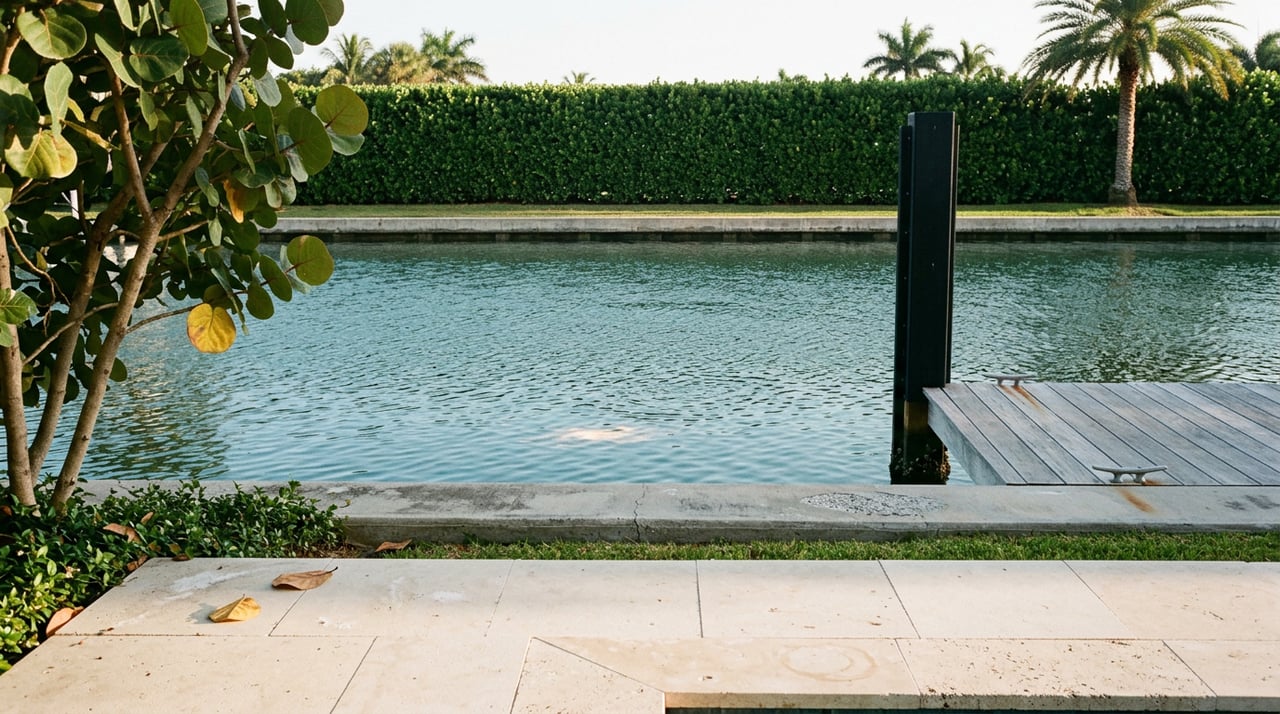
Most of the housing stock on Miami Beach's barrier islands, Star, Palm, Hibiscus, Sunset Islands I through IV, was built between the 1950s and the 1970s. The seawalls that hold those lots together were poured in the same era, against a tidal and storm-surge regime that was measurably gentler than the one South Florida sees today. A structure with a 35 to 50 year design service life is now, on most of these islands, 50 to 70 years past its original pour. King tide overtopping, the kind of event that used to be rare, is now something researchers have documented occurring as much as 14 days a year in South Florida.
None of that shows up in a listing photo. It shows up in a compliance letter, and the city has made that letter matter more than it used to.
On July 23, 2025, Miami Beach updated its Seawall Ordinance, formally titled Resiliency Standards for Tidal Flood Protection. The rule is specific and it is enforceable:
| Requirement | Detail |
|---|---|
| Minimum elevation, new or substantially repaired walls | 5.7 ft NAVD 88 (or 4 ft NAVD with a design that supports raising it later) |
| Trigger for "substantial repair" | Any improvement or repair costing $300 or more per linear foot |
| Time to show progress after a citation | 60 days |
| Time to complete repairs after a citation | 730 days |
| Fines | $250 for a first offense, $500 per day for each day after |
The city's own seawall program page puts the scale of the problem in context: of the roughly 55 miles of seawall protecting Miami Beach, only about 5 miles are publicly owned. The other 90-plus percent sits on private residential lots, which means the compliance question on a barrier island purchase is not a city problem you're inheriting. It's a private one, attached to the specific parcel you're buying. The city estimates its own public seawall retrofit program at $80.3 million as of October 2025, covering design, engineering, construction and inspection on just those 5 public miles. That figure is a useful scale reference for what raising a wall to code actually costs once a project moves from a linear-foot repair estimate into full engineering and construction.
This is the mechanism the median price doesn't capture. Two homes on the same island, similar square footage, similar water frontage, can carry very different real economics depending on whether the seawall in front of them already meets the 5.7 ft NAVD standard or is sitting on borrowed time. A buyer who assumes "waterfront" is a single, uniform category is pricing risk incorrectly in both directions, overpaying for a compliant wall's peace of mind on one lot, underpricing a looming citation on another.
The permitting reform that quietly changed the math
Here's the part that hasn't made it into most conversations about these islands yet, and it matters because it changes what a seawall problem actually costs a buyer in time.
For years, a seawall permit in Miami-Dade County commonly took 18 to 24 months to move through review, against 3 to 6 months in neighboring Broward and Palm Beach counties. That gap was the real cost of a deficient seawall on a barrier island purchase. It wasn't the repair estimate. It was the uncertainty. A buyer negotiating around a seawall issue had no reliable way to know whether "we'll handle it after closing" meant six months of construction or two years of waiting on a county desk.
On July 1, 2025, the Miami-Dade Board of County Commissioners unanimously approved a seawall reform ordinance introduced by Commissioner Eileen Higgins, and by December 1, 2025 the county's new centralized "Gold Key" portal was fully active. The reform sets enforceable review timelines that didn't exist before: a completeness summary within 10 days, no more than three rounds of additional information requests, and a final decision within 90 days of that completeness summary. You can read the breakdown of the new timelines here.
That 90-day window doesn't eliminate the cost of a seawall repair, and it doesn't cover design, contractor scheduling or the environmental clearances that still run through Miami-Dade DERM and, where applicable, the Army Corps of Engineers. But it converts an open-ended risk into a schedulable one. A buyer weighing an offer on a barrier island home with a documented seawall deficiency now has a real number to put in the contract timeline instead of a guess.
What this means island to island
Not every barrier island carries the same version of this risk, and that's worth separating out before you compare notes across them.
Star Island's tight inventory, 35 homes, all waterfront, means the seawall condition of any single property is effectively the seawall condition of a meaningful share of the island's transactable supply in a given year. That's part of why one deal can swing the average so hard.
Palm and Hibiscus Islands carry a mix of waterfront and interior lots, so seawall exposure varies parcel by parcel even within the same gated community. Sunset Islands I and II, reached off North Bay Road, lean more heavily waterfront with private dockage, while Sunset III and IV mix waterfront and dry lots in roughly equal measure. On any of these islands, the listing's water frontage tells you the home touches a seawall. It does not tell you what condition that seawall is in.
What to actually do with this before you write an offer
If you're comparing barrier island properties, the seawall belongs in your due diligence sequence at the same stage as the title search, not as an afterthought once you're under contract.
- Ask whether a current, engineer-sealed seawall inspection report exists, and request it before you write the offer, not after
- Confirm the wall's documented elevation against the 5.7 ft NAVD 88 standard, and whether any prior repair crossed the $300-per-linear-foot "substantial repair" threshold
- Pull open permits and completion records for the seawall and dock, and verify the built condition matches what was permitted
- If a citation or notice already exists, get the date of that notice, since it starts both the 60-day and 730-day clocks
- Loop in a flood and hurricane insurance review early. Standard homeowners policies exclude flood damage entirely, and a documented resilience upgrade, current elevation certificate, or seawall reinforcement can affect both insurability and how quickly a buyer's diligence period closes
None of this replaces a licensed engineer's inspection or your own attorney's review of the specific parcel. It's the sequence that keeps a seawall question from becoming a surprise three weeks before closing.
A few questions worth asking before you tour
Does a compliant seawall mean the home is done with this issue? Not permanently. The ordinance requires ongoing maintenance to prevent erosion or overtopping regardless of a wall's elevation, and enforcement can still be triggered by a maintenance failure even on a wall that met code when it was built.
Does the 90-day Gold Key review window apply to repairs already in progress? The timelines apply to permits submitted through the new portal going forward. A repair that entered the review process before the reform may still be working through the prior sequence.
Is this only a concern for the oldest homes? Age is the strongest predictor, since most of the private seawall inventory dates to the 1950s through 1970s, but a newer home built behind an older, unreplaced wall carries the same exposure as an older structure.
If you're weighing a barrier island purchase or preparing to list one, the seawall documentation is the difference between a clean 90-day timeline and an open-ended one. Jelena Khurana works these islands closely enough to know which questions to ask before an offer goes in, and which ones a seller should already have answered. Reach out for a complimentary home valuation, or a conversation about what a specific address's waterfront infrastructure actually means for your timeline.