If you are deciding between a waterfront estate and an inland estate in Coral Gables, the real question is not just price. It is lifestyle, upkeep, access, and how you want your home to work for you every day. In a market where single-family homes closed in Q4 2025 at a median of $2.05 million and an average of $4.04 million, understanding what drives value can help you buy with more clarity and confidence. Let’s dive in.
Coral Gables market context
Coral Gables has a wide luxury range, and the numbers show it. In Q4 2025, single-family homes closed at a median sale price of $2.05 million, while the average reached $4.04 million, with a median time to contract of 93 days and 5.4 months of supply.
That gap between median and average matters. It suggests a market where typical luxury homes and trophy properties live side by side, especially when you compare inland estates with premium waterfront homes. In Coral Gables, not all high-end homes are priced for the same reasons.
Waterfront estates value drivers
Waterfront homes in Coral Gables often command a premium, but buyers are not simply paying for a view. They are paying for a specific kind of water access, frontage, and boating utility.
The city’s waterways connect to Biscayne Bay, and the city notes that most waterways are navigable by boat. At the same time, public access is limited in many areas because private docks now line a number of canals. That is why you should look closely at what kind of waterfront a property actually offers.
Not all waterfront is the same
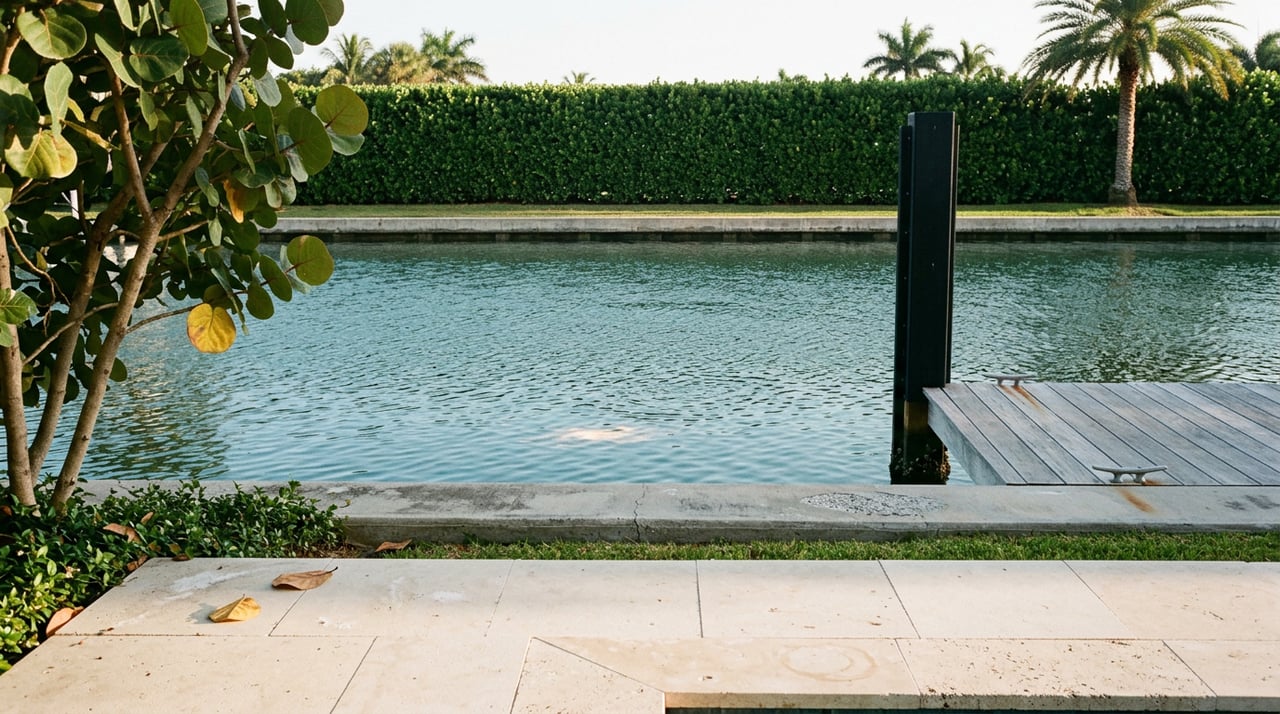
A waterfront label can mean very different things. In Coral Gables, a home may be bayfront, canal-front, lagoon-front, or basin-front, and each option can shape your boating experience.
For example, a Sunrise Harbour estate was marketed with 100 feet of canal frontage, no bridges to Biscayne Bay, and deep-water docking for large boats or yachts. A recent sale in Old Cutler Bay closed at $47 million with 179 feet of water frontage and direct bay and ocean access. These examples show why frontage and access often matter more than lot size alone.
What boosts waterfront pricing
If you are comparing two luxury homes, the waterfront premium usually comes down to a few practical features:
- Water frontage length
- Direct access to Biscayne Bay
- No fixed bridges
- Dock length and depth
- Capacity for larger vessels
- Overall dockability and boating ease
This helps explain why waterfront prices can rise quickly even when inland homes offer large lots and substantial living space. In this segment, the lifestyle use of the property often drives the premium.
Waterfront ownership costs and diligence
A waterfront estate can be exceptional, but it also requires more due diligence. In Coral Gables, flood risk and storm surge are material issues, and the city states that standard hazard insurance does not cover flood damage.
If a home is in a flood zone and financed with a federally regulated mortgage, flood insurance is required. Before you move forward on a waterfront purchase, you should review not only the property itself, but also the carrying costs and physical condition tied to the water.
Key items to review before an offer
For a waterfront estate, make sure you ask for:
- Flood zone information
- Elevation certificate
- Flood insurance quote
- Seawall condition details
- Dock condition and any recent repairs
- Drainage reports, if available
- Information on mangroves or shoreline buffer rules
The city also notes that mangroves are protected under state law, and most trimming requires a Miami-Dade-certified professional trimmer. That means landscaping near the water may involve more rules and more planning than buyers expect.
Inland estates offer a different kind of luxury
Inland estates in Coral Gables compete well because they offer a different value proposition. Instead of paying for water access, you may gain more land control, privacy, flexibility, and easier day-to-day living.
This is important in Coral Gables because inland homes are not automatically smaller or less prestigious. The market includes sizable inland trophy properties with major lot sizes and strong design appeal.
Inland space can still feel estate-level
A current inland example at 7701 Old Cutler Road sits on 1 acre, or 43,732 square feet, with three separate entrances and no waterfront exposure. Another estate on Indian Mound Trail spans 31,529 square feet of land with 12,327 square feet of living area.
These examples show that if you want scale, privacy, and a substantial footprint, you do not have to be on the water to find it. In Coral Gables, inland luxury can still deliver a true estate experience.
Convenience can favor inland locations
For many buyers, daily convenience matters as much as property features. A recent inland sale at 7030 Old Cutler Road closed at $3.2 million on a 13,877-square-foot lot and was described as being minutes from South Miami, Coconut Grove, and Coral Gables.
Central Coral Gables also stands out as the city’s strongest amenity core. The city says its free trolley connects the central business district and MacFarlane Historic District with Metrobus and Metrorail and is designed to support a walkable downtown.
The city also reports more than 60 parks and open spaces and identifies Miracle Mile and Shops at Merrick Park as key retail destinations. Miracle Mile is described by the city as the main dining, shopping, and entertainment corridor.
One detail is worth noting. The trolley does not currently operate on residential streets, so actual walkability still needs to be checked block by block.
Waterfront vs inland lifestyle
The best choice depends on what matters most to you. If boating, dock access, and open-water connectivity are central to your lifestyle, waterfront may justify the premium.
If you prefer more lot flexibility, less water-related maintenance, and easier access to central amenities, an inland estate may offer stronger practical value. Neither option is universally better. The better fit is the one that aligns with how you actually live.
Choose waterfront if you prioritize
- Boating access
- Direct bay or ocean connectivity
- Dock space for your vessel
- Long water frontage
- Open-water views
Choose inland if you prioritize
- More control over outdoor space
- Greater privacy through lot layout or landscaping
- Multiple entrances or easier site access
- Proximity to retail, parks, and central city amenities
- Less exposure to seawall, dock, and shoreline issues
Touring checklist for Coral Gables estates
When you are comparing waterfront and inland homes, it helps to evaluate both with the same disciplined approach. In this price range, small details can have a major impact on value and future ownership experience.
Questions for waterfront homes
- Is the property bayfront, canal-front, lagoon-front, or basin-front?
- Are there fixed bridges between the home and Biscayne Bay?
- What are the dock length, water depth, and lift capacity?
- What is the condition of the seawall and dock?
- What flood zone is the property in?
- What are the current insurance costs?
- Are there mangrove or shoreline maintenance obligations?
Questions for inland homes
- How much of the lot is truly usable outdoor space?
- Does the property have corner exposure or added privacy?
- Are there mature hedges or landscaping buffers?
- Are there multiple entrances?
- How long does it take to reach Miracle Mile, Merrick Park, South Miami, or Coconut Grove?
- Is underground electrical service available on the street?
The city says about 20% of neighborhoods currently have underground electrical infrastructure, with conversion continuing in phases. That can matter for streetscape appearance and the overall visual feel of a property.
How to think about value in Coral Gables
In Coral Gables, value is rarely just about square footage. Waterfront buyers are often paying for frontage, access, and boating convenience, while inland buyers may be paying for land utility, privacy, and a simpler ownership profile.
That is why two homes with similar lot sizes can trade at very different price points. A waterfront home may command a premium because of no-bridge access and dockability, while an inland estate may compete with acreage, multiple entrances, and a more flexible layout.
If you are buying in this market, the goal is not to chase the highest status category. It is to identify which property type delivers the best fit for your lifestyle, your risk tolerance, and your long-term plans.
Whether you are searching for a boating-ready waterfront estate or a private inland residence with estate scale, working with a local luxury advisor can help you compare options with more precision. For tailored guidance in Coral Gables, connect with Jelena Khurana.
FAQs
What makes a Coral Gables waterfront home more expensive than an inland estate?
- Waterfront pricing is often driven by water frontage, direct Biscayne Bay access, no fixed bridges, and dockability rather than lot size alone.
Are all Coral Gables waterfront homes good for boating?
- No. Waterfront homes can be bayfront, canal-front, lagoon-front, or basin-front, so you should confirm bridge clearance, dock details, and actual bay access before buying.
What should you check before buying a waterfront home in Coral Gables?
- Review the flood zone, elevation certificate, flood insurance costs, seawall condition, dock condition, drainage details, and any mangrove-related maintenance requirements.
Can an inland estate in Coral Gables still be a trophy property?
- Yes. Coral Gables includes inland estates with very large lots and substantial living areas, including examples above 31,000 square feet of land and a 1-acre non-waterfront estate.
Is central Coral Gables more convenient for daily living?
- In many cases, yes. The city identifies central Coral Gables as its strongest amenity core, with access to the free trolley system, parks, Miracle Mile, and Shops at Merrick Park, though walkability still varies by block.
Does underground electrical service matter when comparing Coral Gables homes?
- It can. The city says about 20% of neighborhoods currently have underground electrical infrastructure, which may influence aesthetics and the feel of the street.
How long do Coral Gables single-family homes typically take to go under contract?
- In Q4 2025, the median time to contract for Coral Gables single-family homes was 93 days.
What is the main decision between waterfront and inland estates in Coral Gables?
- The main trade-off is usually boating access and water views versus land-based privacy, convenience, and potentially lower water-related maintenance exposure.